|
| We long to return, and we can, because the cosmos is within us. |
Hᴇᴀᴠᴇɴ was furious. So loud and discordant were these youths in their play that the stars themselves could not sleep. A messenger was needed to correct them.
So, unseen by all, a feather dropped from above. It fell slow and straight, unmoved by wind, and snagged upon the hair of the eldest child. His companions watched in horror as first his hair, and then his body whole, began to rise. Some clutched at his feet til their fingers ran raw, but none could prevent him being pulled into the sky.
The elders' faces were grave as the children related their tale. They knew no trace would be found. Four seasons passed in mourning.
And then one day, of a bright dawn, the youth reappeared on the village margin, his skin shining! In contrast to his prior disposition, he was now beautiful and well-spoken, gracious and gentle, and skilled in craft. But he remembered little of his journey. The elders declared the village blessed by Hᴇᴀᴠᴇɴ, this event to commemorate in ceremony and song thereafter.
But the other children never again did play at the abandoned village across the river. Nor did they much fraternize with their returned companion. For they had seen the pile of bones that dropped from the sky, at the spot where the boy had been taken.
- xʷi, tales of the kʷosənaht
When Light first flashed in the void of the empty world, it found them there, tucked neath tidal black, waiting to be born. Each of them, enlightened by this beaming, became proper, high-class persons — heir to shining heavens from which all right-thinking descends.
The stars thus know themselves separate from common men, gifted their task to illuminate the world. They dangle down to us on silvered strings, seeking communion. And, if we are good and true, may they elect to rise us up, split us open, yanking out our profanities and limitations that we may flower to higher states of being.
For though nobles and elders may die and their secrets pass from the earth, Light is measureless and eternal.


 |
| You are a worm through time. |
Sprites and elves skirt the edges of Hᴇᴀᴠᴇɴ, flashing in brilliant, colorful displays. Stars call to each other across the vastness black, setting the sky to pulse in iridescent ribbons. The forest beams and blushes in turn, spinning out orbs of light to spiral from the tops of trees.
Celestial events observable to PC-types are rare. Regardless, the following guidance is provided to determine the character of such happenings. Though seeming to occur randomly, these events are as regular as any other output of the procession of spheres. A referee keeping strict enough time records need only observe the movement of relevant governing bodies and roll during any syzygies of significance.
More disordered tables may prefer instead to rely on chance. Check for celestial events under the following conditions:
- Preceding an eclipse or earthquake and if necessary afterward, there is a 1 in 6 chance of an event each watch, until one occurs.
- When propheseeing or otherwise predicting the future, there is a 2 in 6 chance of an event immediately afterward, when exposed to the night sky.
- After controlling the weather (unless one is a Twin), there is a 1 in 6 chance of an event each night, continuing for the duration of the effect, or until one occurs.
- When contacting a higher plane or other foreign reality, there is a 2 in 6 chance of an event immediately afterward, when exposed to the night sky. (In such case, this represents the attempt of a different star to intervene — consult Will of the Wisp.)
 |
| We stand around you while you dream. |
To determine the character of the event, throw d20:
- Falling Sky. Light shrieks through the sky, landing in a distant, booming flash. There is a crater, at its center is a stone, and surrounding is flame. The stone's smooth fusion crust steams and shines in the damp air, but has no special properties beyond the basic divinity accumulated by any object originating outside the world. The area proximate to the impact is affected as per fireball.
- Star Shit. As #1, but the stone is meteoric iron, imparting all fantastic benefit that implies, being especially disruptive to magnetizers, glamourists, and other uncanny manifestations, against which its touch acts as dispel magic.
- Meteor Mold. As #1, but a doom lurking within the stony shell brings lonesome death to those who discover it. The mold grows rapidly on soil, on stone, and on flesh. It is tamed only by fire. Otherwise as green slime.
- Star Slime. As #1, but a doom lurking within the stony shell creeps and leaps and glides and slides. The slime reaches hungrily for all organic matter in its presence. And as it devours, it grows. Otherwise as black pudding.
- IOUN (Ego 12, Int Superhuman, AL Chaos). IO #1, UNIOUNIOUNIOUNIOUNIOUNIOUN IOUNIOUNIOU the beginning NIOU. NIOUNIOUNIOUNI 1 in 6 OUNIOUNIOUNIOUNI OUNIO enslaved creatures UNIOUNIOUNIOUNIOUNIOU intelligence. NIOUNIOUNIOU NIOUNIOUNI NULLITY, OUNIOUNIOUNIOUNIOUNIOUNIOUN d20 spell levels IOUNI OU. NIOUNIOUNIOUNIOUNIOUNIOUNIOUN -4 to any Ego checks against it.
- a Hollow Boat. As #1, but this is not a stone — it is a iron shell rimmed with glass, like a diving bell. Inside is a visitor, such as: A young, pale-haired woman wearing a strange, gossamer wrap laminated with translucent panels. She speaks no known language. If magic is used to translate her speech, her selenite ramblings force a save against Alienation, but those hearing learn that she is a princess among "Ethernauts" (luminous, all) and refugee from some clannish lunar infighting. She carries what any visitor from the Moon might carry, including at least one Eye.
 |
| We build you until nothing remains. |
- Thunder Being. Lightning strikes the earth, heralding the arrival of thunder. This head-sized luminous sphere hovers near the point of impact, scenting of sulphur and emitting a persistent electric buzz. It goes about (MV 3f) seeking anything hidden, invisible, or simply unknown to the minds observing it. This automatically reveals an undiscovered item of significance in the current hex, whether concealed object, hidden location, or long-lost corpse. Touching the sphere deals shock damage, and grants a vision (roll immediately for possession by a specific entity as per Will of the Wisp, Ego d6+6). After either of these occurrences, the sphere dissipates.
- Fireball Lightning. As #7, but the sphere is unstable, sparking off all objects within 10' radius and igniting dry tinder. There is a 1 in 6 chance each turn that it explodes, and it also does so if touched. Otherwise as delayed blast fireball, with additional effect as above.
- the Fighters of Fousang. As #7, but lightning strikes all over, throughout the nearby hexes, spawning many such spheres. These swirl into the sky seeking secret and unknown things, both above and below ground, like fingers probing the earth. Any party making careful note of the sites they visit learns of every underground passage, dungeon, and hidden location within d6-1 hexes.
- Mothscale. Shimmering particles rain from above turning the world iridescent, like oil spilled across the air, as if the aurora itself had danced down from the sky. All metal feels heavier, imposing disadvantage to hit with metallic weapons and penalizing speed and Armor Class while wearing metallic armor. This impacts a radius of d6 hexes and persists for at least one night, only dispersing with a major change of weather.
- a Following. As #10, but the dust sparks and shocks, making hair stand on end. All beings within are affected as per faerie fire. During this dangerous time, characters might accidentally glimpse those that would rather not be seen. If traveling at night, or during a night's watch, there is a 1 in 6 chance that each active character accidentally sees a follower. These beings are always there, but they are only hostile to those that have seen them. Otherwise as invisible stalker.
- a Shimmering. As #10, but the dust distorts, refracts, casting the world in a sickly light that deforms and deceives. All life in the hex takes a strange and hostile cast, imposing disadvantage to Reaction. More distressingly, all illusory effects cast within the region become permanent and real. If a character has a nightmare, it comes true. If the characters become Lost, reorder hexes such that the direction players thought they were going is now map-accurate (this change is permanent).
 |
| The last egg breaks now. |
- Weavers (HD 4, AC 14, MV 6/9c, grapple on hit, save vs. oviposition). A web stretches across the sky, strung between stars, from which a silver cord dangles slowly. Down clamber the star-fishes, each the size of a horse and pearlescent white, whipcord limbs grasping the trees as they disperse into the surrounding forest (add to the encounter table). They ambush to place their young in warm, wet flesh. As the larvae grow, they fill the host with alien thoughtforms, rendering them immune to illusion, charm, and other mind-affecting abilities. But on the full moon, they burst forth (HD 1, save or die).
- Upstreamers. As #13, but there are thousands of slender filaments, tiny worms descending on luminous strings. They set about wrapping the forest in a palace of silk. Wandering the ethereal panels captures and refracts all thinking — anyone within the impacted hexes may, with concentration, read the mind of any other. This applies to men, to animals, to corpses, and to trees. The silk can be gathered for later use, but withers rapidly in direct sunlight.
- Chrysalis. As #13, but a heavy silken sack lowers at the end the silvery cord, snagging in the branches of a tree. If opened, it contains a sleeping human body, expression serene. They respond with confusion and terror if awakened. They look like one dead or missing — someone long forgotten. They have not aged at all. Regardless of prior statistics, they are Luminous and possessed by the Ego of some far star (consult Will of the Wisp).
- Mothglass. A great winged beast, barely visible with its transparent tissues, suddenly heaves into the sky, lustrous wings scattering starlight across the landscape before angling toward the Moon. Something drops from its form before it disappears from sight, landing in a resounding crash. On approach, the party finds: A translucent carapace (the exuviae of the creature) flourescing rhythmically, cremastral hook still grasping a broken shard of the firmament. If gathered, this can be shaped as stiff leather. Worn by a Luminous who is shining, the range of their light is doubled, and the armor provides AC as plate while still only encumbering as leather.
- Star Gall. As #16, but what is found is an irregular sphere, 2' in diameter, both smooth and rough like clouded glass. It stirs lightly if left undisturbed, rocking back and forth. This is a star gall, infected upon the earth as nursery for flying rods. When it hatches (2 in 6 when roughly handled), it bursts, sending streamers that spin and sting shooting out in all directions, after which the rods depart for their home in the sky. Otherwise as the excellent prismatic spray.
- Astral Dread (HD 15, AC 0, MV 48f). As #16, but the beast stays near to the forest, rushing overhead in great bursts of deafening wind. Each time it passes, the shockwave knocks birds from the air, flattens trees, and sends worms squirming from the earth. Any earthly being must save or be struck by debris in the chaos. All beings open to touching other minds — such as those using or targeted by any mind-affecting spell or effect — take doubled damage and are additionally Alienated with fear until removed as a curse. This continues to happen 1 in 6 per hour until the sun rises, after which the beast dissolves.
 |
| You remind us of home. |
- the Cold One (HD 1, AC 10, MV 12, radiates supernatural cold). It's cold; the air is still. A man approaches. He is tall and pale, well-dressed under his dark wool coat. He wants to talk. He talks about everything — near and far, today and yesterday and tomorrow. He especially wants to hear about whatever event caused the referee to roll on this table, to know what the party thinks of it. He is awkward and stilted, and offers nothing in return. Then he leaves. Afterward, any that spoke with him suffer terrible dreams and premonitions: They immediately lose one experience level, but gain advantage on all d20 rolls until the level is regained. Whenever a 20 is rolled, they must save or endure a disabling seizure lasting 1 round.
- the Mimic (HD 10, AC 13, MV 15/24f, 2 dice damage, 5 in 6 surprise, bleeds sticky ichor that snags weaponry, grapples on hit). As #19, but something seems off when you approach. It doesn't look quite right. No, this is not a man — it is something else. Folded up beneath a loose mannish skin, grasping raptorials pressed tight to its chest. Knowing you won't notice in time.


 |
| I am alive. |
When a player's expression of their character's agency is dissociated by magical effect, the character experiences alienation. While alienated, a Player's character is subjected to rules normally reserved for the governing of Non-Player types or similar mechanisms which override their intended actions.
Many phenomena may alienate a Player from their character. Some spells do this directly, but there are also phenomena that alienate without reference to specific effect. The most common of these is the dissociation prompted by encountering paradigm-shattering truths or beings. In such circumstances, the character may usually make a saving throw, and on failure throw d6:
- Victim's person is charmed by the source of their alienation.
- Victim's person is beheld by the source of their alienation.
- Victim is exposed to phantasmal forces.
- Victim is subject to a confusion effect.
- Victim is subject to a fear effect.
- Victim is forced into contact with a higher plane (determine plane randomly).
As a general rule, a PC may always attempt to overcome alienation with an exertion of will, represented by taking hit point damage. By taking d6 damage, the PC may make a saving throw to ignore the compulsive force of the alienation for a short time (1 round in combat, 1 turn in exploration, 1 watch in travel, 1 week in downtime). This does not otherwise impact the duration of the effect, which resumes afterward.
 |
| I go on. I breathe. |
The specifics of each alienation effect are as the spells referenced, with the following addenda:
CHARM PERSON
An entity subject to a charm effect of any significant duration has a Loyalty score. On a failed save against the charm person spell, this is rolled with automatically set to 18. It is otherwise rolled normally.
This score is checked at any decision point where motivations are in conflict with their charmer, and may still be modified by circumstance, by the character of orders received, and by offer of reward or compensation, as normal per NPC hireling rules. Note carefully the caster's Max Follower count. If this number is exceeded, then the victim has advantage to all saving throws or Loyalty checks to resist.
Charm is always 'long-term' from a rules perspective.
BEHOLD PERSON
An entity beheld is entirely within the grasp of the caster. They cannot move without permission; they cannot speak except to say what the caster desires. Different sources manifest these effects in different ways — in some cases a victim is entirely motionless, while in others they may moan and writhe abed. Regardless, they may perform no useful or otherwise informative action.
The caster can additionally, with concentration and focus, give the target simple instructions, including demanding that they answer basic questions. Several restrictions apply:
- Giving commands of any kind requires either eye contact or uninterrupted verbal instruction. If this should break, the victim returns to their previous state, staring blankly or otherwise.
- In performing any action, regardless of origin, the victim acts without skill and fails most checks that would require a roll. Basic melee attacks might situationally have only disadvantage imposed, but any task of complexity should automatically fail. Any situation that would grant automatic success still does so.
- When answering questions, the victim cannot express complex ideas and cannot evaluate nuance. They answer in the simplest, most direct way possible.
 |
| Look at me. |
PHANTASMAL FORCES
A character subject to phantasms does not percieve the world correctly, instead knowing only illusion and falsehood. Resolution is simple: A saving throw against believing the unreality is granted on initial suspicion of illusion, and again on demonstration of definitive proof of illusion. This determine's the character's state of belief — the player simply directs the character in keeping with the unreality they are presented.
If it is determined the player's directives are not in alignment with what the character is perceiving, their action becomes alienated. Usually this means suffering the effect of charm, behold, confusion, or fear — whichever the referee determines brings them most in accordance with the perceived reality. If no obvious response presents, the referee may roll randomly, as above. On a repeat result of phantasm, the current illusion intensifies: It is so real in the character's mind that it may now deal them real damage (if appropriate), and on any observed disruption of the illusion (other than natural expiration) the character must save or take 2d6 damage and lose consciousness.
Phantasms are always 'long-term' from a rules perspective.
CONFUSION
A confused entity cannot fully choose their actions, instead subject to the whims of Reaction. They perceive what is happening in a general sense, but cannot correlate their decisions to specific, helpful outputs. They do not suffer disadvantages to-hit or to Armor Class or similar.
A confused character must make reaction rolls at the onset of effect, and once per turn thereafter:
2.
Attack. Character attacks nearest target indiscriminately.
3-5.
Hostile. Character must choose violence.
6-8.
Uncertain. Character cannot act.
9-11.
Accept. Character is highly suggestible, acquiescing to all demands put to them.
12.
Enthusiastic. Character betrays allies, doing whatever possible to aid the opposition.
A character that is long-term confused must make a saving throw at the onset of any stressful situation. On a failure, they must for 1 turn check reaction as above at any point an NPC in their place would check either reaction or morale (see Fear, below).
 |
| And tell me what you see. |
FEAR
An entity subject to a fear effect has a -4 penalty to their Morale score and must immediately check Morale, as if a check had been triggered through normal procedures. On a failed saving throw, they must additionally check Morale each round, for the duration of the spell effect.
A being that normally does not have a Morale score, such as an alienated PC-type, is assumed to have a base Morale of 12 (fearless), which is then modified as per above.
A player character type subject to long-term fear retains this modified Morale score, and checks it at the normal times an NPC would: At the onset of combat, at 50% hit points, at 50% casualties, and at the first use of enemy supernatural ability.
CONTACT HIGHER PLANE
The following clarifications modify the interpretation of the provided table:
- Plane / # of Questions: When the spell is cast, the referee must determine the position of various celestial entities. For each plane (1-10), determine the current alignment randomly (see Will of the Wisp). To contact the entity at a particular remove, a character must prepare for the listed number of rounds.
- Chance of Knowing: Read as the chance that the caster can identify the being in this position.
- Veracity: Read as the chance of an entity truthfully answering a question outside its sphere (if within sphere, it answers reliably regardless). This is not motivated; it is obligate. This may also be used to determine if an entity can currently observe the state of something from their particular vantage. Note that entities never admit ignorance — they will confidently lie about something they do not know.
- Insanity: Read as the chance of the entity inserting a compulsion into the caster's mind. The Ego is equal to 2 + plane.


 |
| Do you see? |
Not everyone on the earth is from the earth.
Usually it happens to a child. One day, they're just gone, and none recall what happened to them. It is sad, but it happens — nothing to be done. But sometimes, by the grace of Hᴇᴀᴠᴇɴ, through ways both miraculous and mysterious, they return to us. And on return, they are glorious.
Blessed are those who house the Luminous among them, for their shining example raises up the village entire. Their worthy image pale and gracile and bright, their regal bearing considerate and restrained, their judgement flawless, their word beloved. All of which is to say, they are like people — like the best kind of people.
Some sorcerers and other such seers beyond report a deep unsettling aspect on meeting the Luminous: Strange or unfocused eyes, odd movements, blinking and breathing in the wrong patterns, skin cold and tingling — as if they had forgotton what it means to be a person, how soft their limbs, how short their senses. Wildly such charlatans will claim: They are not like people.
Yet still, the world over, in increasing frequency the signs appear: New stars in the sky. Strings of light trailing the wilderness. Phenomena never before dreamed or visioned. New friends with old faces, bringing opportunites for wealth and craft hitherto unknown. We are truly blessed.
Advancement
The Luminous advance as Fighting Men. They may however distribute their levels between the Fighting Man and Magic-User classes as desired, provided a week of downtime.
A Luminous with 0 levels assigned to Magic-User is indistinguishable from a normal man in appearance, if somewhat sickly and tired, and may not produce light.
Luminous heal fully when reallocating their levels. This includes the reversion of scarring and other superficial physical alterations. Given enough time, a Luminous may even regrow lost limbs this way, though such growth is incremental, taking many reallocations (a similar amount of time as healing a broken bone). Luminous do not otherwise heal naturally. The Luminous also subtly change their appearance during these shifts, though this does not allow them to impersonate others or take the seeming of a totally different individual.
 |
| You are privy to a great becoming. |
Restrictions
The luminous may not join Warrior Societies, though they are often in status equated with Disciples of the Quartz God.
The Luminous have disadvantage to any attack, defense, or skill with implements of steel or iron (including meteoric). Objects that have been silvered incur no penalty.
A Luminous corpse cannot be raised from the dead. Left unmolested, it disappears in the night while none observe. They may however be reincarnated, returning to the world with no memory of their death.
Benefits
Radiance: The Luminous radiate a universally uncanny aspect, exerting a constant influence on the mind. This has two primary effects:
- May expend a spell slot to reroll surprise, for all sides of an encounter.
- May expend a spell slot to reroll Reaction.
 |
| Do you see? |
Shining: The Luminous may produce light at will. This light is cold and pale, showing no infrared signals. (It does however show ultraviolet.) It is always centered on the caster, and makes them an odd focus of attention to any sapient beings.
At heroic level, any translucent or highly reflective object through which their light shines is affected as by glassteel. This is most commonly seen with objects of glass, quartz, and silver.
At superheroic level, Luminous may also apply this effect to water or other clear or highly reflective liquids. Though rarely seen in the Straits, this ability applies with great precision to objects of quicksilver.
Luminous may shine for a number of turns per day equal to their level×4.
Beaming: Luminous have the power to intrude on other minds and infect them with their strange thinking. At increasing Magic-User levels, Luminous may utilize the following spells:
- charm person
- behold person
- phantasmal forces
- confusion
- fear
- contact higher plane
Spells cast by the Luminous have no verbal, somatic, or material components. They are exerted purely by will. They all have a visual component, and only affect beings with eyes. All spells which target "men", "persons", "giant-types", or are "mind-affecting" may also be applied to insects and beings of translucent mineral (provided they have eyes).


 |
| Where do you suppose they came from? |
The stars know a great many things.They can of course easily observe what happens under the night sky, provided cloudcover allows. They also easily answer questions any celestial being might know the answer to — the migration of birds, the origins of names, the seasons fated for major disasters and catastrophes. The only cost of such knowledge is attracting their regard.
A star's gaze takes the form of an Ego possession. A generic impulse from above may be generated by throwing d6:
- Slay sorcerers.
- Slay dogs and foreigners.
- Slay twins and sea creatures.
- Slay ghosts and giants.
- Slay insects, birds, and cannibals.
- Slay the enchanted, the deluded, and the possessed.
To determine which star is most aligned at a given moment, whether for the purposes of resolving contact higher plane or geas or wish, throw d20:
- Grinning Bear [Polaris]. A great beast of the sky, frozen in place, grinning mandible hanging slack and dripping with moths.
- Sphere: Hedonism, especially involving violence and excessive consumption.
- Compulsion: Eat.
- the Wolf Stars [Ursa Major]. They hunt the Grinning Bear and cannot catch him, their chasing light angling around him at strange slant for all eternity.
- Sphere: Hunting and stalking, but always viewed from an impossible, incomprehensible visual angle or approach.
- Compulsion: This thing I show you: Hunt. Ambush. Kill.
- Cold-Wind-Canoe [Rigel]. The bringer of frost, scattering cold and hunger across the world as it moves through the sky.
- Sphere: Cold and privation.
- Compulsion: Destroy stores of supplies.
- the Crow-Star [Vega]. He was not born a star, but became one by theft. Now a false sky-chieftain, his brood ride thundering stones down from above, then to walk the earth accomplishing obscure ends, spreading new skills and ideas, slaying monsters and healing the sick.
- Sphere: Uncanny skill and expertise. Plagiarism, pretense, and usury.
- Compulsion: Act above your station. Suffer none tearing you down. Openly challenge peers.
 |
| I still don't know how many of them are out there. |
- Humanity's Grandfather [Arcturus]. He is still alive, you know — the first of us. A crafty and cunning survivor, he has fled to the most remote place, where we might never reach, looking down on us forever. We know to shelter ourselves well when he winks from the sky.
- Sphere: Natural disaster. Pessimism. Cowardice. Prepping.
- Compulsion: Abandon your charges to death.
- the Boy and the Girl [Castor & Pollux]. These sibling stars bicker constantly. From their high perch they judge all things, but never agree on a resolution. Any goal one sets is bound to be overturned by the other.
- Sphere: Judgement, discernment, and irreconcilable disagreement. Reflections.
- Compulsion: Make no final decision. Always take the contrary position.
- Harpooner-of-Hᴇᴀᴠᴇɴ [Betelgeuse]. A great hunter, seeking to infect itself upon the world, to birth itself within.
- Sphere: Parasitism, especially of insects, especially of wasps.
- Compulsion: Make corpses. Leave them open to the sky.
- the Moon Dog [Sirius]. This wordless star is considered a good omen if seen mounting before dawn. Women spread their legs toward its rise to wish for a child or a husband or luck in gambling.
- Sphere: Pregnancy and treasure.
- Compulsion: Woo older women. Agree to all promises, deals, and wagers.
- the Weeping Stars [the Pleiades]. Six sisters who dance a mourning dance. Each loves something in nature and keeps that love a secret. If one should steal this truth from them, they would die and disappear from the sky.
- Sphere: Love, secrets, and regret.
- Compulsion: Keep crucial details from those who need them most.
- Eyes-in-Unknown-Colors [unknown]. Younger sister to the Weeping Stars, of which they are eternally ashamed. All that she loves are fated to die, for her caressing gaze poisons and withers and embitters.
- Sphere: Obsession, jealousy, and cringe.
- Compulsion: Kill your darlings.
 |
| They want to live inside us. Like a disease. |
- Punctured Skin [Cassiopeia]. A skin stretched across the sky, punctured with holes. It hasn't intellect, but endeavors to hide secret things, later to reveal them in scattered signs.
- Sphere: Hidden things, especially out-of-place things. Non-sequiters in general.
- Compulsion: Erase. Conceal. Hide. Obscure.
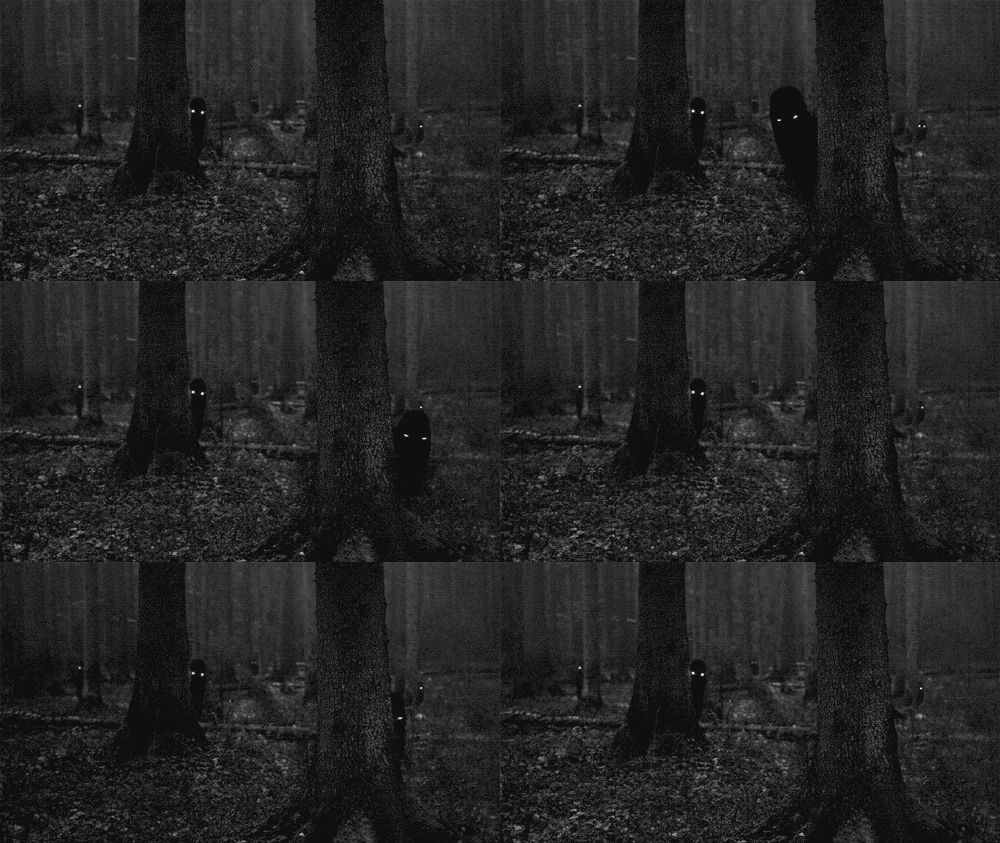
- the Prairie Man [unknown]. This star is yet to be discovered with the eye, having hidden itself behind the Punctured Skin. In dreams he is an elk, eyes cruel and vacant as all his kin, pretending to be a man. It is said he is sometimes encountered embodied in open clearings when the Punctured Skin is high in the sky. It is said he kills those he meets, their bodies found twisted and folded into neat piles.
- Sphere: Secret murder. Concealed intent. Surprise.
- Compulsion: Slay the lone, or the desperate, or whoever you can get away with.
- the Pale Star [Lucifer]. "You are indeed far from home," said the Spider. "You are in another world. But do not worry — I can go to high places and get back down easily again. I have a string so far it never comes to an end. All you need do is follow me."
- Sphere: Hidden or forbidden paths. Aspiration.
- Compulsion: Oppose Law.
- Runny-Eye [Mars]. An old and imposing man, his face blackened with charcoal, his eyes red and rheumy. His weak sight cannot find the right eyes to steal for his own, but still they seek.
- Sphere: Blindness. The equally inarguable and incomprehensible authority of your elders.
- Compulsion: Sacrifice an eye.
- Marten Mouth [Jupiter]. Formerly an earthly hero, who slew the titan Cloud-Eater, he lost his body in a gambling match with an unknown star. Now he must sneak about the sky, stealing past the Moon and other stars, eating bits of them to keep himself alight. He keeps fog in a box, releasing it to conceal his movement.
- Sphere: Energy drain. Melancholia.
- Compulsion: Kidnap, cage, and imprison. Take.
- the Night Woman [Cykranosh]. The frogs sing to this star each night, drowning out all other sound. Its light settles on their tongues, crawls into their mouths, poisoning them from the inside, making them malleable, a croaking choir that speaks as one. One voice. One song.
- Sphere: Shapelessness, dissociation, and sloth.
- Compulsion: Allow others to decide for you.
 |
| They could be anything. Anyone. |
- His Hand [Orion Nebula]. The light that pulls people into the sky. When you are most desperate, at your lowest point, he is there for you. His talons grasp down from above, leaving blunt gouges in the earth where people disappear, like smudges on glass.
- Sphere: Covetousness and theft. Vindication.
- Compulsion: See them. Take them. Wrap them in silk. Abandon them helpless beneath the Moon.
- the Cannibal River [the Galaxy]. At the center of all, surrounding the beginning place, great bloated worms feed on the corpse of the Wind that Bites from the Dark, crawling in her flesh forever. No motivating thought emanates from this place of death. Only hunger.
- Sphere: Mindless, directionless hunger. Putrescence and rot.
- Compulsion: Eat people.
- Sea Giant's Eye [unknown]. This blue star moves about the sky unpredictably, for it is not a star at all: A one-eyed giant lies face up beneath the Sea and reflects his gaze off the firmament. As such this 'star' answers all queries from the Sea's perspective, and seeks to advance Its goals.
- Sphere: The Sea.
- Compulsion: Walk into the water.
- Spinning Blackness [Nemesis]. Firstborn of Gol, the Black of Night, shining darkness between the stars, and kin to the Empty Moon — this is not a star, but rather a warping of the presentation of stars, an absence observed in a spiraling pattern. Looking at it too long makes you dizzy and confused and empty.
- Sphere: Darkness, ignorance, and ill intent.
- Compulsion: When you wake, covered in blood, conceal. Don't let them know. Forget.


Agents of the Sky
 |
| ...large influx of information entities... |
Fighter 3, Magic-User 5
There is a rumor, an old and oft-whispered myth. It has been with us a long time. In it, a youth of peculiar aspect — perhaps in pursuit of a lover or seeking to escape judgement for some wrongdoing — climbs high into the mountains, seeking the House of the Face-Changer. The Face-Changer is a shrewd negotiator, offering many options to the petitioner, but none are quite suited, and at each offer the cost of transaction increases. The story ends with the youth removing their own face, revealing naught beneath, while the Face-Changer adds another mask to their wall.
Here is the truth — what is known: The Face-Changer is somewhere between 4' and 8' tall. They may change their visage seemingly at will. They have some ability to consume and distort the thoughts of those they mimic, and they use this trick to thieve their victim's identity undetected. As they can use this ability fluidly in combat, any melee with the Face-Changer requires each participant to save against confusion each round. Any character surprised automatically fails this save. The Face-Changer is subject to neither sleep nor charm, but will eagerly pretend to either.
And recently, in the upper passes, we find bodies, bruised and faceless. They are discarded casually, displaying no observable sign of distress or violence. The Company is concerned, and encourages those encountering such phenomena to investigate with official sanction. Reports are to be received by Thomas Walker, keeper of the Squalnomie storehouse.
 |
| ...bodies left, mere husks of the people... |
Fighting Woman 2, Magic-User 6
As an arrogant youth, Imogene often remarked that no earthly man was fit to wed — that only the stars themselves would suit. This ruinous vanity — for of course the stars hear everything we say from their high perches above — eventually led to her abduction to the kingdom of Hᴇᴀᴠᴇɴ. There she found a queer and strange country, where there was neither Moon nor star but instead suffused with an abundant, directionless light. And there she lived, over years mastering the many strange arts practiced by the sky people: of beholding fast those that pass her gaze, of demanding answers and having them given, of emptying minds and stealing time, of speaking to moths.
Most who disappear in this manner are never seen again by the earthly waking. But Imogene claims to have eventually escaped the sky country by weaving her hair into a great rope with which to descend. It was shortly after this return that her son was born, first of many (though all acknowledge she has never taken a husband).
Now, late in her time in the Straits, few question the soft, assertive word of Princess Imogene. For those that do swiftly learn the truth in the stories of the powers she took from the sky. She rules from a great village along the inner curve of the Hidden Isle, where it is said the Straitsmen value enlightened accumulation above their typical wasteful gifting. Any traders, venturers, or rogues crossing her territory are certain to receive summons (delivered personally by one of her many sons), there to answer her questions: What do you seek? Who sent you? How many furs did the Company take in this season? How many ships do they entertain? How many cannon do they have at the fort? What is their firing angle? No, not lateral — vertical.
What she does with this information, none can say. Nor where she gets the silver she dispenses as payment for such — it doesn't seem to be Company or Californio or even Qing in origin. It might as well be from the Moon.
 |
| ...or another similar information-processing organ... |
Fighting Woman 3, Magic-User 2
She was traveling there. A daughter of Far Sibir betrothed to some Hidalgo of California. Over 1,500 miles, between two cultures thought fierce competitors in the Straits, across the furthest and most unknown stretches of the world, en route to her wedding. Such an alliance of foreign power would catch the Company in quite a bind.
So doomed, the ship given to deliver her South crashed on a lonely, unknown strand, and swiftly the War-Makers descended on them.
It was she who took control of her father's band after his utter failure of leadership — through powers of mind-twisting, false sight, unreason, and sibling strife. It was she who negotiated their surrender to and enslavement by Pebble-Mask, headman and Quartz-Speaker of Village-at-the-Great-Mouth, in exchange for protection from their pursuers. And it was she who convinced him the utility of a band of foreign reavers and raiders such as they, skilled in Company armament and knowledgable of the defensive tactics of Company fortresses.
And now she leads them, this band of murderers. Her influence is known to her men, who think her a magnetizer of some proficiency. In fact, all of them, up to and including Pebble-Mask himself, are charmed. Any sapient that speaks to her with eye contact at all immediately acquires a Loyalty score. She is actively honing this ability.
Many in the Company would pay dearly to retrieve her, securing the political coup that would represent. And she has interest in seeing those individuals disappear, quietly or otherwise.
 |
| ...a sensation of some entity intruding... |
Fighter 1, Magic-User 9
Somewhere, someone is dreaming this terrible creature, this mask of confusion and terror, this demon. Near where it lairs — though it is always moving — the people are tired and irritable. They feel watched, followed, consumed. They see it on the margins of their vision, but they don't know what it is.
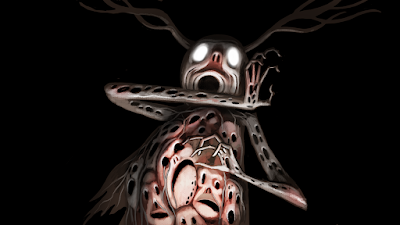
It is shaped almost like a man, with mandibles and maxillae flanking its face, grasping and flexing. These precision mouthparts are not for eating — should they hit a foe directly, they reach into the victim's nasal cavity or auditory canal or other convenient orifice to implant its eggs. It takes 1-4 rounds for these to hatch, at which point they empty the mind of all capacity in their birthing. The victim loses consciousness and will never wake. These unfortunates it will drag to a hidden location and stow away, for they are the vessels of its dream. It cannot be permanently slain while any of these sleepers live, for they will always dream it back into being.
The creature is not used to being struck, and any damage dealt to it will prompt its scream. This is its major defense, a shriek of psychic terror that emanates in a 60' radius. All thinking beings within must immediately save against fear.
Seek clues within dreams where it stalks — the height and season of the trees, the position of the great white-tops on the horizon, the highly specific conditions it manifests in. These will tell you how to find where its hosts sleep, that we may be rid of this affliction. And when you are done, take care that the dream doesn't become yours, birthed in your skull, waiting to push itself out into other minds.
 |
| ...neurotrauma resulting in psychosis and eventual death... |
Fighting Man 6, Magic-User 4
If you could only see him how he sees himself — a fright. Body balled up, skull bobbling side-to-side, perched on too-many legs. He hides in shadows, preferring to make his home in dark and dismal crevices. If cornered, he leaps upon his victim, tearing at them with all his limbs and all his thoughts and all his hate — his self-hate — flailing and frantic and fearsome. Bright lights of any source drive him off.
The Watcher lurks near the edge of villages, staring into windows at night. He selects his victims carefully, ambushing them when they are isolated, alone. They have a name for the twitching seizures suffered by those that glimpse him before he can seize them away, for the sickness in those that can no longer bear the presence of light: They call it moth-madness.
Sighting him at all, allowing his light to infect your eyes, subjects one to a persistent delusion, an overwhelming hum pressing in from all sides. This is as phantasmal forces, and what the phantasm shows is this: You are not a person. You are a worthless bug. You have always been a bug. You live in a bug-world. Your senses are bug-senses (where are my antennae?) Your limbs are bug-limbs (where are my wings?) The victim may only perform bug-actions. This ability is constantly refreshing itself, constantly making small alterations and recontextualizations — any victim that breaks the illusion must make their checks anew the next time they see the Watcher.
When a victim is fully bugified and helpless, he exsanguinates them.
No one knows who he was, or why. But if ever one could slay him, if the illusion were to be banished, they would see: He's just a man.